Monday, December 13, 2010

Valley of the Dolls

Today was surprisingly cold. All right, not as cold as Canada, I’ll give you that but it was definitely not hot. The wind choked the heat right out of that big old sunshine. It also brought in a haze which Ramses told us was sand from the desert. This started in the morning and by late afternoon the sun looked more like the moon and the day presented as overcast. The air was filled with dust and the locals had their faces wrapped. Some were watering down the streets to reduce the dust. It made me cough and sneeze and the air had a dusty smell to it, like an attic that hasn’t been cleaned in a while.

We started the day visiting the ladies of the dead valley. Their tombs are separate from the men like the old school dances. Seems a bit weird if you ask me but apparently this was the done thing. Princes, nobles and princesses all had their own spots too. Queen Nefertari, the wife of Ramses II had her tomb here. This is one tired woman. I bet three thousand years of sleep hasn’t caught her up yet. Don’t forget, she had over 200 kids! Her name means “most beautiful of all women”. Yeah, right. Not after 200 kids. Her tomb was closed to the public…

The tombs were interesting and well preserved but we couldn’t take pictures. Again, the helpful guards pointed out pictures and we coughed up the obligatory baksheesh. We do carry the coin but there’s something about being forced to “give” that sucks the fun right out of it.
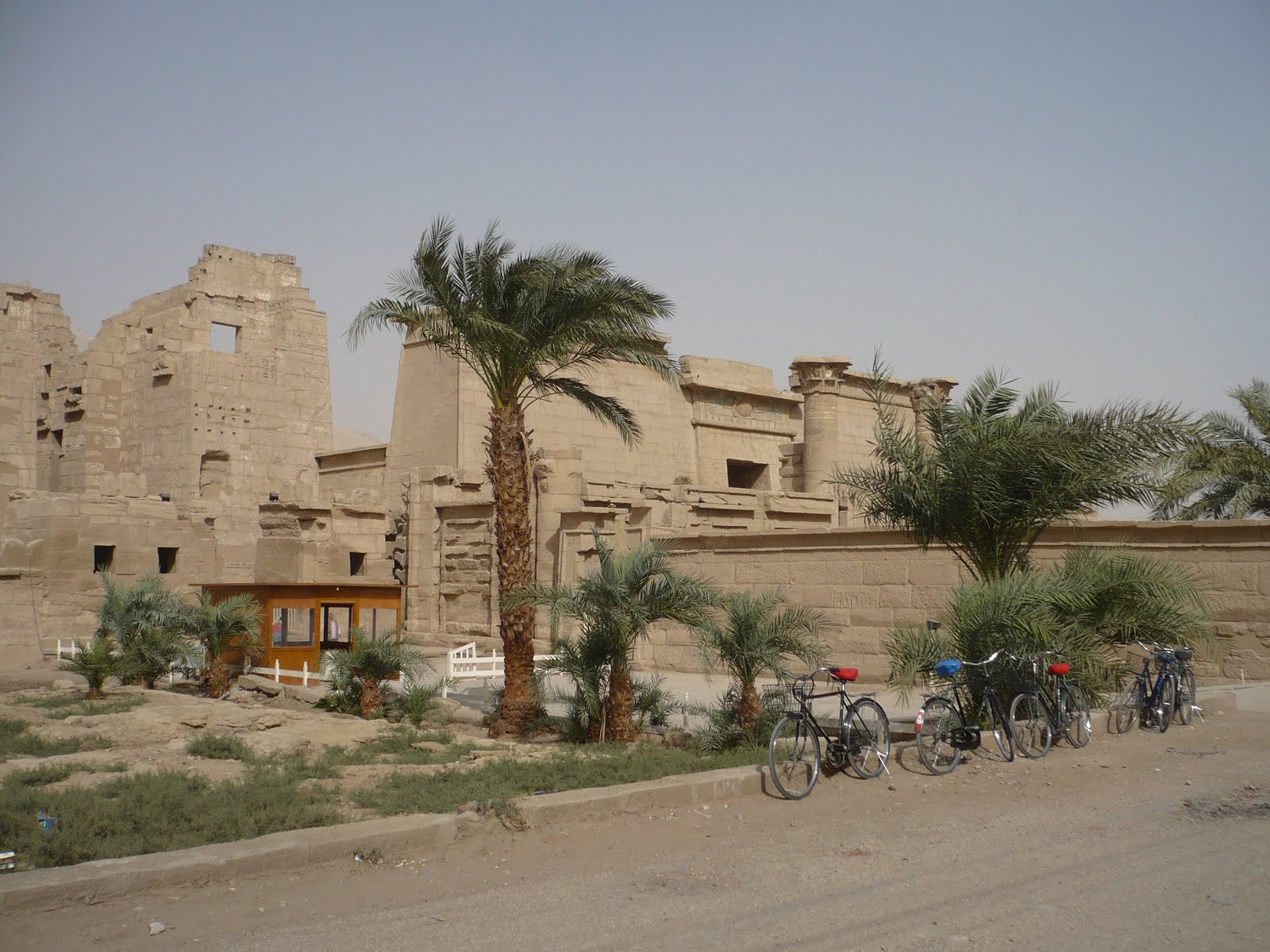
We went to Medinet Habu after the tombs. This is the last mortuary temple built. It was built for Ramses III. It was pretty impressive. The walls, columns and ceiling were covered in hieroglyphs. Some of the paint was still there and surprise...we were allowed to take pictures! These hieroglyphs look similar to those in the tombs so kind of pretend you know what the rest looked like. Some of these were carved REALLY deep. The deep ones were cartouches and we figured that by Ramses III, they had figured out that the each pharaoh who came along enjoyed defacing the names of prior pharaohs so they better dig really deep if they want the thing to last.

When we got into the hypostyle hall a guard began to drag me into the forbidden areas. I told him I had no money and apologized. He told me it was no problem and continued to lead me around. I reluctantly followed and we took copious quantities of pictures of me in front of various hieroglyphs blocked from public view. Frequently, I reminded him I had no money and resisted following but he insisted. It was actually a great tour and I saw interesting pictures. I even have a picture of me pretending to touch a statue because the guard thought that would be an excellent idea. At the end he launched into the sad story of the many children he has and could I please give him a little something. I reminded him I had no money which was true. He was extremely disappointed and asked me to look in my purse. I offered him my pen but he wasn’t impressed.

The tours of temples and tombs has been really cool but our ride on camels today topped it all. It cost about $30 for the four of us to take a one hour ride and that included a tip that was as much as the price of the ride! It was a lot like riding a horse. The camels were very soft and their feet were soft as well. They don’t have hooves like horses. Their feet are more like calloused skin.

On our ride we went past banana fields, sugar cane fields, mango and lemon trees and a cool little village. We also saw a crocodile-like lizard in the water which was about a metre long. The boys didn’t know what he was called. It’s never good to be on a first name basis with crocodiles. The village, homes and people were fascinating and I thoroughly enjoyed the trip.

They still use animals to plow the field. I haven’t got a picture of the water buffalo but they till the soil, and the farmer walking behind then plants the seeds. As the buffalo walks up the next row, the dirt plowed for the seeds in the last row is dumped back over the seeds and a new row is plowed. In thousands of years, they haven’t found a better way to do this. Interesting. A water buffalo is a very valuable animal to the Egyptians. It can cut their food budget in half. As well as helping farm, it gives milk which can be drank but also makes a yummy butter and cheese.

They use donkeys to carry crops into town and you can see them everywhere along the side of the road. The donkey waits while the farmer cuts the crops by hand. They load up their wagon with the greens and drive in to town or back to the stable. The greens feed the farm animals. Horses don’t seem to be used as widely, probably because they cost more to feed.

Everything about the Egyptian’s lifestyle is so foreign and fascinating. It has been my favourite part of the visit so far.

Sunday, December 12, 2010

And...back to Egypt

Today we went to the Valley of the Kings. Wow! We walked through the Valley of the Kings. We explored several tombs including King Tut’s. It was hot. It was dry. It was strangely normal. Last Saturday we were cross country skiing at the base of the Austrian Alps. Today we stood in the Valley of the Kings. That had me laughing somewhat hysterically at lunch today.

The Valley of the Dead was the driest place I think I may have ever been. The earth around us was composed of hills of stone covered with rubble. The hills were a warm beige and had a parched look about them. There wasn’t soil. There was dust. It coated our feet as we walked and blew in our eyes when the wind picked up. We saw no animals except flies. THEY got in your face and had the annoying persistence of a caleche tout. There wasn’t a green plant in sight. No scrub brush, no tree, no weed, nothing. We saw the remains of what looked like it used to be a plant as we drove out of the valley but within the area, it was, as its name implies, dead.

On our way, we stopped at Howard Carter's house. Howard was the archaeologist who discovered King Tut's tomb. His house is oasis in the middle of the arid rock. It was really neat being there, though, because I have read quite a bit about him and his discovery. Also, his last name comes in handy for interesting pictures.


We arrived around 8:30 in the morning but Ramses told us most of the tour buses arrived around 6 am. The valley wasn’t crowded because the tours mainly come on Friday at the end of their week excursions. Everyone normally arrives and leaves on a Saturday. We paid for our tickets, paid for the train, paid for a guide book, paid for more tickets, paid for water (it comes in bottles in this valley), paid the guards who pointed out little things we might not have noticed. None of it was overly expensive but it nickels and dimes you to death…heh, heh.

The guidebook turned out to be money well spent. It had a map and information about the tombs. There were no descriptions anywhere to describe anything, except for Tut’s tomb. There are over sixty tombs that have been discovered so far but your ticket allows you to see only three. You pay extra to see Ramses VI and Tut. We paid the extra. It is difficult to make a decision on which tombs to visit. Ramses, (the cab driver not the dead king), told us which ones to see but when we got in there none of us could remember his recommendations. The names don’t exactly roll off the tongue. It’s not like he said to go see Fred, Bob and Larry’s tomb.

Most of the names sound very similar because the pharaohs would assume a god’s name as part of their own to symbolize their godlike status. For example, Amun is the leading god in these parts so Tutankhamun and Amenotep both have Amun in them. Akhenaton changed his name to reflect his new belief in one god, the god of the sun, Aton. Akhenaton is the one Joseph visited. Joseph helped him interpret some difficult repeating dreams and saved Egypt from famine so Akhenaton decided to dump the old multiple god beliefs and follow Joseph’s one god theory. This didn’t win Akhenaton any friends and he was murdered some time later. Akhenaton was also married to Nefertiti.

It was wonderful entering the tombs. The entrances varied in length, width and height. One tomb had a metal staircase to climb up into the rock hill and then on entrance, you had to walk down, down, down into the hot stone. Many times you had to duck your head and it must have been quite something trying to get the sarcophagus in there. The tombs were surprisingly hot. I mean sweaty hot. The further in you went, the further it heated up. Only a few had fans inside and that just blew the hot air around. When a new pharaoh was crowned, an architect, chief stonemason and vizier would climb into the valley to select a spot for his tomb. This was a huge honour because only a select few knew the location of the tombs. The artists and craftspeople who designed the tomb’s interiors all lived in a village on the West Bank and did not fraternize with the general populace. Speaking out of turn meant certain death.

They must have discovered the other tombs in their selection process because many are very close together. Ramses VI is right overtop of Tut’s. Actually, Ramses VI is Ramses V/VI because the son decided just to usurp his dad’s tomb and they are buried together. Ramses II’s tomb is interesting as well, though we didn’t get inside of it. He is the one who had over 200 kids and being the family man he was, he had rooms for each of his sons added to his tomb. He’s the only one who did this as far as we could see. It is quite the complex, as you can imagine.

Paintings covered the walls of many entrances but some hadn’t been finished. The paintings showed images of the gods enacting various events from the Book of Gates, Book of Caverns, Book of Heavens, Book of Dead and so on. Well read bunch. Many of the paintings were not in very good condition but it HAS been three thousand years or so. One of my favourite paintings was the ceiling of the tomb in Ramses V/VI burial chamber. It showed Nut, goddess of the earth and sky covering the heavens.

We left the Valley of the Kings and went to see Hatshepsut’s temple. Hatshepsut was an interesting pharaoh because she was a lady. She was one of the only female pharaohs. Her father, Thutmosis I was a pharaoh. Her husband, Thutmosis II took over from him and when he died she took over. She ruled for 16 years quite successfully but she must have been one interesting character. When her son, Thutmosis III took over after her death, he began defacing her monuments. Her body disappeared from its tomb and was only discovered recently. Other pharaohs also dismantled monuments she had erected so there isn’t much left of her around. I don’t know if this says more about her personality or the male ego but when we get a good internet connection, I want to find out.

Ramses took us to a great café for lunch. It reminded me a lot of Turkey. The food was fabulous and similar to Turkey as well. The food has been unexpectedly delicious. We had no idea what Egyptian food was like but fear not! When you visit, the food is great! One nice thing is that when you order a meal here they bring all the accompanying foods with it. We ordered tagine, which is a stew made in a clay dish. It also came with pita and a curry flavoured humous-like dip called tahine, a plate of fresh salad vegetables with vinaigrette, fried eggplant which was surprisingly delicious and rice.

After lunch we visited the ghost town of Deir el Medina. It is where the artists and craftspeople I mentioned earlier lived. It was a bit of a disappointment because there wasn’t a guide. The best we got were the guards who would point to various pictures in the tombs and identify the gods. They each needed to be paid, of course. By the end of the day we had NO small change left and were forced to run when we saw the guards coming. The tombs we saw in the village were very well preserved. They belonged to the head artist. In his free time he would decorate his own tomb. It turned out very well. Obviously, the tomb artists and craftspeople did not lead a life of desperation.

You weren’t allowed to take any pictures inside the tombs so I have none to share. This one is from the Deir el Medina temple. You’ll just have to come see the tombs for yourself.

Rothenberg

Rothenberg was a small walled medieval town that had a friendly feeling to it. We also did a wall walk around part of the wall, and that was cool because of all the names of people who had donated to Rothenberg on the wall. In our short stay, we went to 3 museums. The first museum was some sort of monastery. Embedded in the monastery's wall, there was a halved barrel on a swivel so that the nuns/monks/whoever could anonymously give food to the poor.


For some reason the monastery had somebody's private collection of medieval weaponry inside. The person collected quite an astonishing number of deadly weapons. They had one of the first pen knives there; and it was all eaten away at. They also had gotten hold of Marie Antoinette's hunting rifle set. There were guns, spears, sets of armour, swords, knives, daggers, chainmail, and much more. They had a picture of how they would battle with the swords and daggers, and it looked pretty gruesome. I'm not sure how the monastery managed to obtain the collection, but they did none the less.

The monastery also had a funny statue of Moses with horns because the craftsman thought the description read “cornuta” which means horned instead of “coronata” which means crowned. I laughed out loud when Mom told us this. The other statues the monastery had were probably from the streets around town. Mom found a picture that she liked and I knew the place where the scene was in real life, so I showed everyone and there it was.

This was a fairly big museum with a fairly large variety of objects. It had a device that medieval women would wear because their husband didn’t trust them when he went out of town and wanted them to stay “loyal” to him. The "Chastity Belts" might also be used if the woman just feared for their own safety in a particularly bad town. It looked like a steel lasagne-strapped iron bikini bottom. It was a little odd to be around.


The second museum we went to was the oldest house in town from like, 889 A.D. or 889 years ago, I can't remember which. It was unchanged because it was inhabited by a hermit. The floor was the original; hard clay with rock paving stones. There were 3 floors, and it was made exclusively from wood. On the bottom floor there was an indoor well, and an indoor toilet (what a luxury; It must've been added in later!). There was also some sort of shoemaking room, and a sewing/weaving room. Over the years lots of different people have inhabited the house including Coopers & Weavers.

On the second floor, there were 3 bedrooms; the master bedroom, and two children's rooms. You wouldn't be able to tell they were children's rooms had it not said so until you looked at the beds in one of them (the beds were smaller). There were no toys, and not much entertainment. In an average marketer’s home, you might find 4 or 3 bedrooms. 3 of which are split between 10-15 children. 10-15 children was normal. There may be indoor or outdoor wells or toilets. There would be a definite lack of indoor heating.

On the third floor, the attic, there was a bed in a cupboard inside of a small room. The room's size was about 1/3rd of the size of the attic. When we were there the attic was filled with typical junk you might find in your own attic. The attic wasn't originally used for this purpose though. Almost every house had a beam coming out of the front of the house. The beam was used as a crane to get grain up into the attic for siege storage. The attic was an excellent place for the grain because it was clean, high, dry, and away from the, wet dirty streets.


The third museum was about crime & punishment. There was one of those things that people threw food at you when you were in them. They had funny masks and more chastity belts and cool boxes. They had a spiky chair and a stretcher. They also had a lot of lists of punishments for crimes. There were levels of punishment. They had things that held you in a position that made you look like you were playing the violin. They had a thing that held 2 people together, but it was basically a double violin thing so if there was a couple that weren’t getting along they were put in the thing until they did. They also had thumb presses for torture and jingle boots to alert everyone that the criminal was coming with a funny mask on. They also had a thing for bad musicians. It was like a clarinet, but it didn’t work and you were fixed in a single pose. I think they had the most humiliation masks.

Saturday, December 11, 2010

Egyptian Adjustment

There was no bounding out of bed with restless enthusiasm on Friday. We slithered quietly out. Julia announced she didn’t like Egypt and didn’t want to leave the resort. Regardless, Ramses was coming to pick us up at 10:30 so we prepared ourselves.

On the way in to Luxor we told Ramses what had happened the night before and he was horrified. He told me we should have told him the night before and we would have gone back to pick up the offender and throw him in jail. He made me describe the man and said he thought he knew who it was. By the time we reached the restaurant for breakfast, I was afraid he was going to hunt down the man and bring him to justice. I was envisioning a line-up at the police station and a long day of statements. At the restaurant Rhys said he wanted to break the man’s leg. We were all working the incident through in our own way.

After breakfast Ramses drove us to the Luxor museum. It was excellent and very interesting. We learned a lot about the various kings and daily life in ancient times. There were a couple of interesting movies as well. The biggest drawback was that we were not allowed to take pictures. We had to walk from the museum to the Karnak temple and it was with some trepidation that we started on our way. It was a beautiful day, however, and the bright sunlight made everything seem less frightening. Even the touts didn’t push as hard…or maybe we were just getting better at showing absolutely no interest.

Karnak temple in the sunlight was even more spectacular. It is actually a series of temples as Luxor (formerly Thebes) was the religious centre of Egypt. Many pharaohs had made their mark: Seti, Ramses II and III, Hatshepsut and Tut. We wandered around taking pictures. A guard asked us to enter an area that was blocked off and encouraged us to take pictures of ourselves with the statues. He wanted us to climb on them but we declined, agreeing that we would try not to contribute to the erosion any more than we already were. He needed to be paid, of course but the most interesting part was that another guard showed up at that point. Obviously, he was a supervisor and when we gave the first guard money, the first guard handed it right over to the other one. Interesting. It must have really irritated him to do it.

The temple’s most spectacular area was the hypostyle hall. It was the largest in existence with 134 towering pillars. Each column was engraved with hieroglyphics from top to bottom. Some of the columns had blocks stretching between them on top and the undersides were painted. At one time, it had all been painted. It must have been amazing when it was in its glory, although the common folk never got to see it. The inner complex was only for the priests and pharaohs. We spent a good two hours wandering around the sight taking pictures.

During our wander, we saw several school groups. The first group of girls found me amongst the columns in the hypostyle hall. They eagerly approached saying, “hello”. I returned the greeting the first time which caused each and every one of them to repeat so I could greet them in turn. Then one asked, “What is your name?” so I told her and asked her name so she told me. Then every other girl repeated the question in turn. At this point their young male teacher rounded the corner and asked one of them to take his picture with me. ? So, we posed for a picture together and I asked if he would take a picture of me with the girls which he did and then gave my camera to one of the girls so I could have a picture of myself with him. Then each of the girls wanted an individual picture with me and finally we all said goodbye.

A few corners later, another school group appeared and when I replied to the girls they all swarmed me so that one of the guards came forward to shoo them away. I guess I must have not looked too panicked because he backed off and I played “ask and answer” with the girls. They were very sweet and I really enjoyed talking to them. Suddenly, their male teacher came along and began shooing them away from me like they were chickens or something, yelling at them angrily. I suppose “swarm the tourist” is not an encouraged activity on school fieldtrips. It was far more enjoyable than playing duck and weave with the touts.

One of the more interesting facts we learned is that Ramses II had over 200 children. There's an awful lot of material there but this is a family blog. We found a birthday card from his kids though. Isn't it sweet that they all signed it? It continues on the next rock, of course.

After our excitement the night before we decided to end the day when the sun was still shining, grabbed some food from the supermarket and headed home with Ramses. Tonight we dined on homemade pizza made on the stovetop. We forgot we had no oven.

Harassed and Harangued

I bounded up in the morning, raring to go. I got ready and was out the patio door to explore our resort. We front onto the Nile so I immediately walked around the swimming pool and out to the river. I stared out across the river and absorbed the history oozing out of it. Scum gathered at the edges of the water, along with a shoe (thankfully without a foot) and some plant matter. On the west bank was an image straight out of a textbook on Egypt. Palms surrounded the muddy, flat-topped buildings and blue sky shimmered in the background. To my right I could see the mountains which protect the valleys of the dead. To my left the Nile rounded a bend out of sight with nothing but green bushes on either side. How is it that I can be in a part of the world inhabited by people for thousands of years yet not see resort hotels and skyscrapers as far as I look?


Ramses, the cab driver not the pharaoh came to take us into Luxor. We started with lunch at the Oasis Café. On full tummies, we set out on a walk to the Luxor temple. We walked up the main street, “Corniche” with the Nile on our left. It should have been a lovely walk but the constant harassment by Egyptian touts left us cold. They offered caleche rides, felucca boat cruises, taxi rides and other things I can’t think of right now. A caleche is a horse drawn buggy. They are everywhere and the touts don’t take no for an answer. They follow you along haranguing you in the hopes you will relent. Even if one gives up, the next one is right there to take up the call. Even if they watched you say no to the last five, each one seems to feel they have a right to make the effort by standing in front of you to force you to walk around them. It was exhausting and intimidating.


Finally we arrived at the temple. The huge statues, obelisks and columns were inspiring. The sun was low in the sky and so the ruins cast interesting shadows across everything. There was a wide street with sphinxes on either side leading away from the temple. It used to lead from the Luxor temple to the Karnak temples, a three kilometer distance. Can you imagine walking a street lined with sphinxes for three kilometers? That’s a lot of cat. The city is trying to restore the road now and they have cleared all the buildings covering the earth so they can excavate it to its former beauty. It should be amazing when it is done but I bet it is causing no end of controversy right now for those displaced! The people or buildings they are moving may have been there for hundreds of years!

Throughout our wander through the temple, we were met by curious gazes. I began to feel like I had something on my face. The guides, guards and guests all stared as we walked around. Some of the visitors were children and they giggled and stared, whispering to each other. Once a little girl got up her courage to say, “hello” so I smiled and said, “hello” back. Her next word was, “money?” Sad.

Tom wandered in a different direction at one point. I was alone looking around when a guard motioned me with his finger to follow him further away from where I thought my family might be. He was smiling but I was a bit shaken by all the strange attention so I felt very uncomfortable. Rhys appeared and the two of us followed him together. The guard showed us an inscription in the wall which people touch to bring good luck. He took each of our hands to touch the wall, then our head three times and then the wall and our heart three times. Then he took our picture with my camera at his insistence. Then he held his hand out for money. I don’t carry money but I managed to dig up a British pound coin which he accepted. We then repeated the whole procedure with Tom and Julia. More guards signaled they wished to show us things but at that point we declined as politely as we could. We have found this behaviour from guards is the norm at tourist sites.

We went from the temple to the Mummification museum, weaving our way through the throngs of touts wanting to give us rides. One actually asked what he could offer that would make us give him money. The museum was small but excellent. We weren’t allowed to take pictures, unfortunately because there were some fascinating items. We saw a mummy, preserved skin from a foot, a piece of preserved flesh, a mummified head that had been halved to reveal the cavity which had once housed the brain. It is now stuffed with linen. There were lids from sarcophagi and a mummy looking rather blackened and dead. However did mummies get the white bandaged look? Every one I’ve ever seen (and I’ve seen quite a few now) has been black and shriveled looking, and far more spooky than some old toilet paper doll.

We walked to the Karnak temple for the rather weak sound and light show. The guidebook said it is the best one in Egypt so it will be the last one we see. The walk was far more exciting than the show. We took a dark and quiet road by mistake and wound up in an area we probably shouldn’t have bothered walking through. Although I was holding Tom’s hand and walking with my children, a man brushed up against me and tried to grope me. This caused a significant amount of horror and rage from all of us and greatly contributed to our already unpleasant impressions of Egyptian men.

The Sound and Light was as cheesy and underwhelming as it could have been but the temple at night was spectacular. We caught a cab to the restaurant after the show, too shaken to attempt another night-time walk. By the time we got home, we were all wondering how we were going to cope with another day of harassment and anxiety.

Friday, December 10, 2010

First Impressions of Egypt

We are well outside our comfort zone here. Landing as the sun set yesterday was spectacular. The sands stretched out, the Nile snaked, the palms rose up and we landed in a place I have only read about it books. We had arranged to stay at a resort-type place and this turned out to be a good idea. Egypt is not a place to “do it yourself”; at least, not for us.

It was no problem passing through customs and having gaining our entry visa. A person from the resort met us as we entered the airport and slapped the sticker into our passport before we even met the official. We paid him for the visas which seemed odd but nobody else questioned this so we continued. He gave us a sign to hold up on the other side of customs and as we left we met a second man who led us to the waiting cab. Our walk from the airport to the cab cost us about $4. We paid the fellow who gave us our visas. We also had to pay two men who grabbed our bags and pulled them to the vehicle. One complained we didn’t give him enough but Tom stood firm.

We arrived at the resort and the apartment turned out to be a three bedroom place much to the glee of the children. Sadly, there is no internet so in order to communicate we have to plug in at the office for short periods. Maybe this is a good thing? We had some food at the apartment waiting as I had requested but it was mainly breakfast foods. We asked our host to call a cab and set out for dinner. We are several kilometers outside the city so it would be difficult to walk.

The cabbie was a riot. His name is Ahmed but calls himself Ramses IX. I don’t know why but it works. He made us feel a bit more at ease as he gave us his evaluation of what to do first and so on. He dropped us at the restaurant with a promise to pick us up when we were finished. We could pay him when we got back to the resort.

The restaurant reminded me of a movie set. I cannot think of a specific movie but it seems to me someone was chasing someone else. Maybe an Indiana Jones scene? It was similar to the Turkish restaurants in décor but felt so Egyptian. The upstairs room was open with heavy carpet-like curtains rolled up to reveal the buildings around us in the streets. While we dined we watched a man raise and lower a basket from his third floor apartment, obviously receiving some sort of goods. Another person kept emptying buckets of washing water into the street from the top of a different building. It was clear that when you parked you needed the covers most cars sported. The food was delicious, cooked in clay dishes and similar to the Turkish dinners we had. No alcohol was allowed because it was a Muslim restaurant. Tom dealt with this admirably.

The dinner was reasonably priced but not cheap and the restaurant was filled with tourists. Ramses was waiting for us and drove us home saying he would wait for our call in the morning. As we drove we passed many wagons pulled by donkeys, many people wearing the long gowns and headgear you see in movies about the desert and odd shaped motor vehicles of varying sizes. The cars do not use their headlights at night if the streets are lit. They only flash them at each other to alert the other vehicles they are approaching. They also use the Turkish method of honking on approach. All of this served to create a sort of brain overload for the four of us and we were thankful to reach the safety of our European-like resort and go to bed.

Sunday, December 5, 2010

Movin' On


We will be sad to say goodbye to Hopferau. This area of Bavaria is quite delightful and our week here has been relaxing and fun. The castles were spectacular but it was the scenery that really delighted. Yesterday's skiing just reminded me of how much fun winter can be. When the snow is in the fields and not the road, the sun is shining and the air is clear, winter sports are the best. Gotta keep travelin' on...