Art class.

Yesterday I went to an art thing that was a lot of fun. Dad came along, but basically he just wanted to know what kind of paint to buy. The drive was a very long confusing drive but in the end it all worked out. So starting the flash back *%* Doodooloo*%*:
We left with everything we needed for art. I had my elastic around my wrist and dad had the phone number we needed to call and the actual phone. Nothing could go wrong, but we obviously found a way to make it go wrong. It was a long boring ride and the GPS was being very difficult to work with. Eventually we got there.
We were supposed to meet at the gas station but we couldn’t find it, although we knew we were in the right town. Then we decided to forget about the gas station and just focus on calling them, because chances are they would know the whole town and be able to find us. It wasn’t a very big town. Dad took out the cell phone and turned it on and it said ‘Punch in pin’. Dad turned and said “What’s the pin, Julia?” I looked at him and said “Dunno”.
Dad got out of the car and looked for a phone, which didn’t take long because there was a phone right beside us. Out of order. I wasn’t very surprised though. He got back in the car and we drove around town, luckily (sort of) a random lady kept pointing right and said ‘Yahblehdoneck spanyoten’. Well, it sounded like that and I’M telling to story…not you. So dad turned right following Yable Lady’s finger and she was pointing to the Gas Station! So we got there, but how could we meet them if we couldn’t call!?
Dad asked people for help while I sat in the car trying, and failing, to sleep. He got back in, in about 15 minutes and said ‘There’s another phone by the Clinic.’ So we went there and it worked! It was embarrassing though when I heard dad “CAN YOU HEAR ME?!?” But I got through it.

The house was gorgeous. Amazing gardens and views…but it was in the middle of no where. The studio was great, that was good because it was cold out and I wore shorts. So we started out painting the poster. Not exactly the poster but the idea of what came to our mind. Both of us had very different ideas. Mine was bright and bold. Dad’s was mellow and warm. We were supposed to put hands in it and that’s why I don’t like mine. Both the paintings are just sort of trying out what we like and different brush strokes. Though, I do really like the bottom of mine.


Then we had lunch. It was very cold. Cold potatoes, and tomatoes. Hehe. I tried a prune. I don’t like prunes. It was a good lunch but very non-filling.
After lunch we went out and looked at the Garden. Then chose something to paint from the garden. I choose a tree. Yesterday I really wanted all my pictures to be bold and weird. Like Dali. I can now see why Dali painted the things he did, because it’s more fun to paint like that! With bright red and Yellow.
After the walk we went in to paint what we wanted. I started out by painting the back ground red. REALLY red. I used the thick brush because…well, because that brush is fun to use. Then I went to the bathroom and when I came out there was no one there! I would’ve waited in the studio, but that would have been boring! I walked to the front door and one of her cats ran in!
She doesn’t let her cats go in. So before I could start looking for them I had to find the cat. I looked in the kitchen. No cat. (ok, lets just fast forward to the studio) so I went to the studio and found the cat. But WOW! This cat is a really good hider. He or She was behind a painting and I NEVER would’ve found her if it weren’t for her tail flicking back and forth.
I found the cat and shoed her out. Then I looked in the outside office and found dad and the art teacher. Dad was printing out the picture on his camera. I guess nothing out side he really liked. Then we all went back in.
I painted four paintings all together. I finished painting the tree one. And started painting what is now my second least favorite. Then I painted the rose arch, from her garden. I loved the rose arch so why not paint it? It’s my favorite one. I put a lot of effort in to the tree and the rose arch. With lighting and three different shades of green. It's still a little lop-sided though.

Dad said he didn’t like painting on canvas. He used very watery paints though. He needed to because of the light colours in his picture. He said it was a sort of waxy canvas so the water colour didn’t grab as well. Mine worked perfectly though, I didn’t use any water in my thick colours though.
Me and dad both have very different styles the teacher said. It’s true. Dad’s really are not very bright and mine aren’t very realistic. At all. Except the tree if you don’t look at the background and only look at the tree … with out the lemons. It’s pretty good.
Thursday, April 21, 2011
Art Class

Sunday, April 17, 2011
Sevilla
We made an overnight trip to Sevilla this week.  Sevilla is about 3 hours away. It is a HUGE city and driving was a nightmare. We opted for a map at one point which was a mistake as it didn’t show one way streets and strangely angled corners or streets made for goats rather than vehicles. We wound up driving in a nasty maze of inner city streets and eventually reverted to our GPS to help get us out again. Streets aside, the inner city was wonderful and we had a great time.
 Flamenco dresses and so on for sale in stores on the street. I don’t mean the tourist kind, either. There are real stores that sell this stuff to real Spanish people. It still exists. In fact, some women own a different fan for every outfit. It seems ridiculous in Canada but after living in the heat here, a fan has become a more attractive accessory. It’s only spring but already the temperature gets up to around 30 degrees during the day. We can almost sit out on our deck late at night but I still need a sweater. Give it another couple of months, though, and it will be a sweltering 45 degrees in the afternoon sun and most families won’t retire until after midnight because of the evening heat. Glad we’ll miss that.
 Where will his next trip be? Those guys carrying him must be getting tired.
 Muslim occupation and then a Christian cap. The very top of the tower now houses bells and a huge statue of some Christian type figure whose name I can’t remember. Obviously impressive, though.
  urtyards, Muslim looking arches and so on. The most interesting thing about this is that it was built by Christians in the Moorish style. The tile is geometric in many places but also has lots of images of animals and people. The Muslims don’t believe in recreating images created by God. The best part about the Moorish palaces is the garden areas. They always have such lovely open areas inside. This one also had a great garden in behind as well.
  eople don gowns and parade through the streets at Easter to ask forgiveness for sins. It really has nothing to do with the KKK, although the thought of buying a sweet candy penitent didn’t sit well with any of us. There is a full size one on display at the grocery store near the Easter candy and Julia felt it was creepy looking. Hooded figures don’t exude charm or encourage one to linger at the chocolate area. Mind you, I suppose candy, children and horror costumes at Hallowe’en don’t exactly mix well either.

 ng hat is Jesus. I thought briefly he was also holding a broom but he is NOT.

Sunday, April 10, 2011
Nerja
About 40 minutes from us is a lovely little coastal town called “Nerja”, pronounced "Ner-ha". 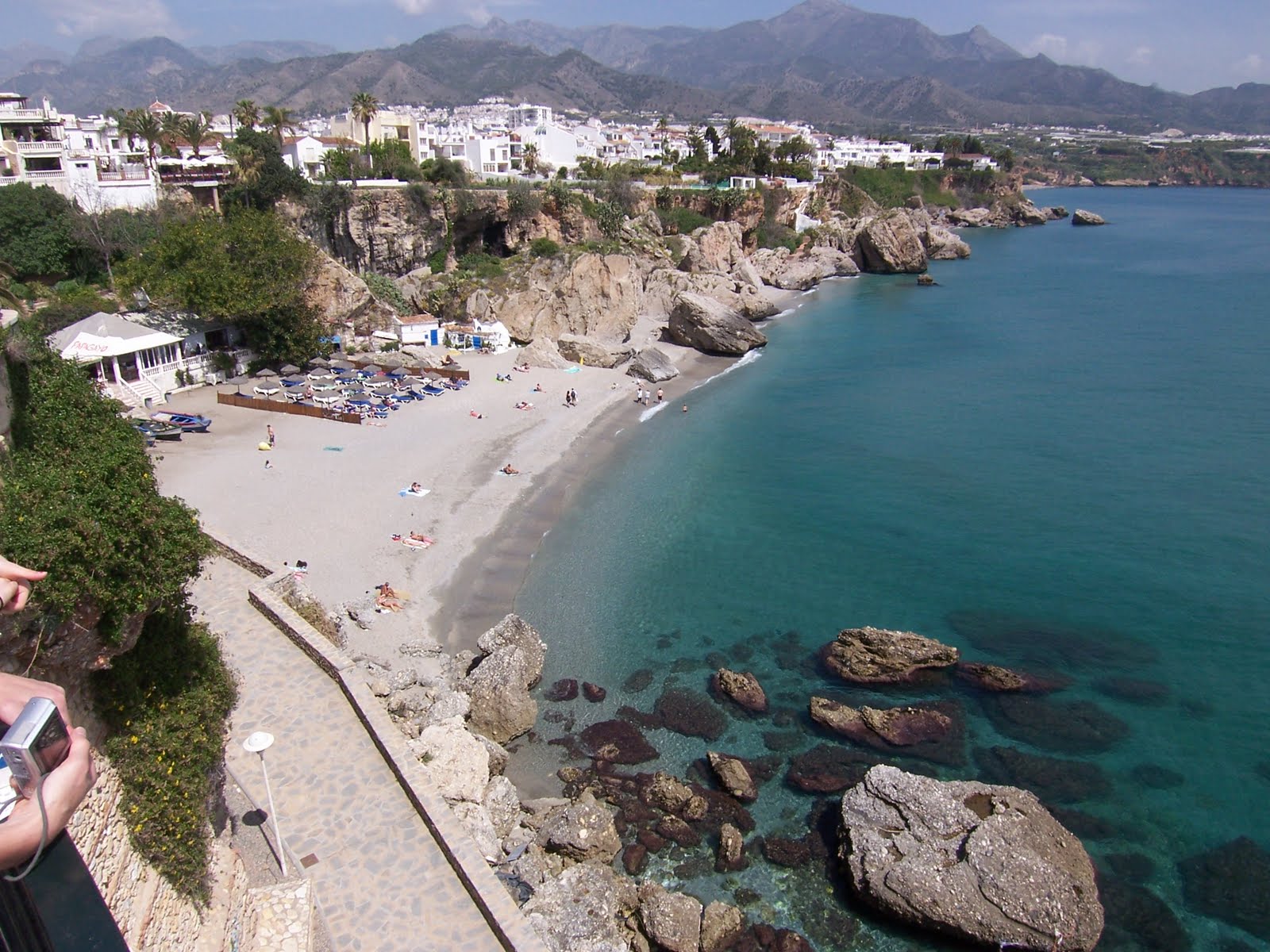 It is known as the “Balcony of Europe”, a phrase coined by a Spanish king when he came to survey the damage done by the earthquake in 1884. Nerja is beautiful and has beautiful beaches as well but its real claim to fame are its caves.
 dramatic stalactites and stalagmites. It has the largest cave form in the world inside, according to Guinness. It is a stalagmite/stalactite combo that is 32 metres in height and larger than an ancient Sequoia in girth.

 y to spoon a bit near the edge.
  hout Spain because it was easy, cheap and filling. I can’t imagine the poor farmers had quite as much meat in their paella, though.
  After lunch, we rolled our bloated selves onto the beach and lounged along with the rest of Northern Europe. It was fun listening to the wide variety of languages spoken around us. The Scandinavian group nearby seemed like fun and I thought it was a shame we didn’t speak their language. Mind you, add a never-ending flow of beer to any group and I suppose they’ll be fun. The water was cold but many people still went swimming because it was hot. Julia joined the ranks and took her first swim of the year. The rest of us chose to wait. We may not have long to wait though, because the weather ha
 s definitely taken a turn for the hot. It was 30 degrees on the beach!
 Granada
We decided to take an overnight trip to Granada.  It is only 1.5 hours away but it seemed like an awfully long day trip and there was a lot to do in town. In planning, I realized that you had to make a reservation to get into the Alhambra (the reason so many visit) and that the place was almost fully booked all month because of the Easter celebrations. The only time available was the next day!
 In fact, their zest for Christian domination was such that they would have lit the world if they could.
  o gain a stranglehold on Spain, spreading more fear and suspicion than love and eternal life. In the ensuing years, they succeeded in pushing out the Muslims and Jews and creating a Catholic country, albeit a rather subdued Catholic country.
  The focus of the cathedral is on Mary as the newly converted Muslims who stayed had an easier time praying to her because she is in the Koran (Muslim bible). Inside the cathedral they still have a huge pictorial work displaying Saint James swinging his sword atop a horse while a Moor writhes beneath the horse’s hooves. That had to chafe at the new converts.
  one should eat pork because Muslims and Jews can’t eat pig meat. To show you were following the correct faith, you ate pork. Even today you can find more pork dishes than anything else. The grocery store has a whole aisle devoted to ham hocks. This move helped to prevent Muslims and Jews from returning to Spain as well. There are some 700,000 Muslims living in Spain today and 5 million living in France. I guess it worked.
  Isabel received Christopher Columbus and agreed to his terms for sailing west to discover the east. We saw the room where this happened; a perfect cube of a room, perhaps appropriate for a sailor about to prove the earth was a sphere. I thought it was interesting also that Rick Steves said that most people didn’t believe the earth was flat at this point but simply thought it was far bigger than Columbus had calculated.
  Ferdinand and Isabel. They may have gone about things in a frightening manner but they are credited with uniting Spain. Their bodies lay entombed in a chapel next to their grandson and his wife. I wonder how they feel about that. Philip the Fair died before his wife, Juana the Mad. Juana was so overcome with grief that she had his body set out in her bedroom and kissed him goodnight each evening for TWO YEARS. I believe this may have been when “the Mad” was attached to her name. I wonder if this is why the bodies of Spanish royalty now have to “ripen” for 90 days before they can be entombed in the El Escorial pantheon.
  We saw an old caravanserai, the last of the original fourteen camel watering holes. When travelers would come to Granada, they’d stop at these places to sleep, sell their wares and swap stories. This place was completely hidden by more modern buildings surrounding it. Not far from the caravanserai was the Alcaiceria (muslim market in the style of souks). The streets were very narrow and the multiple shops sold mostly the same tourist junk but it was fun winding our way through it. Way back when, it was created as a silk market and had armed guards. Silk was a very important product controlled by the sultan. We didn’t see any silk but we did see the Roma ladies who push rosemary at you in the hopes they’ll con you out of a few coins by telling your fortune. We didn’t fall for it. It was tame compared to the Egyptian souks and the poor gypsies didn’t stand a chance.
 n Spanish. Not sure how the Roma feel about that one. There were also lots of Flamenco bars but we had already decided to go to a show in Sevilla, capital of Flamenco.
  Just when you think you’ve seen it all.
 Monday, April 4, 2011
In Search of the Sun
We drove from Lisbon south to the Algarve.  This is the sunny south coast of Portugal where snowbirds from the north fly each year seeking the heat. We stopped for lunch in a lovely little town called Olhao. We were not disappointed by the temperature. We left Lisbon at 13 degrees and arrived in Olhao at 26 degrees. That was a 2.5 hour drive. Imagine driving through half the country and doubling your temperature in 2.5 hours! Makes one think…
 However, we left the coast along a torturous winding road through the hills to the tiny village of Almachar where we have rented a house for the month. The coast is about a 20 minute drive. If you are a bird it probably takes about 5 minutes because you are not slave to the scary, “we’re all going to die here” roads. Most of the towns we passed cling to the side of the hill and I was glad they weren’t Almachar because they made me quite breathless. Our village clings to the side of the hill but at least the bottom of the hill is also the bottom of the village.
 This is by far the nicest place we have stayed. There are three floors built around a central courtyard in the Moorish style. The courtyard is not open to the sky but has a large skylight covering it letting in the light. There is a terrace entry that looks out onto the street. Our front door enters into the dining room which has heavy curtains in the doorways to help keep the heat in should we need it. The courtyard is next and then a Turkish looking living room beyond. The kitchen and a small bathroom also reside on this floor. The courtyard has a large staircase that winds up to the next two floors. The middle floor has a
  walkway around and four bedrooms and two more bathrooms open off of this hall. At the top level there is an open foyer where we have set up the computers, another bedroom and a large rooftop terrace with a killer view.
  information prepared for the surrounds. Judy even prepared a list of events taking place over the next month in the small villages nearby. Of course, the first three days we spent just sleeping in, lounging on the rooftop terrace and indulging ourselves. Oh, that was just Tom and I. The kids worked on schoolwork.
 Sunday, April 3, 2011
Post Heather Sintra
We dropped Heather off at the airport early in the morning and then headed home to gather the children for a trip to Sintra.  Sintra is what must function as the Loire Valley of Portugal. The rich and famous settled themselves here, building palaces to reflect their stunning wealth. It was first founded by the Romans who called it “Cynthia” after the moon goddess. We had no idea what to expect but the lush tropical greenery was definitely a surprise. We felt like we had stepped into a jungle. Somebody back in time must have been a horticulturalist because there were trees from around the world on one of the palace properties. They even had Sequoia! It felt like we were back home in the forests of BC, although the foliage was just a bit too thick
  looking, with lots of vines. Vines really aren’t a BC thing.

 The castle dining room seated about twenty rather than 144. It felt very liveable. The living quarters were built around a huge interior courtyard letting in light to all rooms. Pena has been compared to Neuchwanstein and other Bavarian castles by Mad King Ludwig but it was the final palace that we thought most reminded us of the crazy king. The whole palace was surrounded by extensive gardens with plants from around the world. We were on a bit of a tight schedule so we opted to skip the garden tour and go for lunch instead.
  Gaudi didn’t participate in this estate but you could see he would have loved it. The mansion was wonderful with a library whose floor appeared to float. The room was poorly lit and when you peered through the door you could see that the floor didn’t reach to the walls and the stacks of books appeared to extend from the floor below right up past you to the ceiling above. It gave one pause. A couple of men stood in the doorway, wanting to go in but unsure how the floor was supported from below. I mean, one wrong step and down you go.
  What kind of tourist trap was this? We could see a door on the other side of the room and as Tom pointed out, if it was dangerous they wouldn’t have the open doorway. The men wouldn’t move out of the doorway though. They wouldn’t go in but they wouldn’t move to allow others in so I went down and around to get to the other doorway. By the time I got there, Tom was in the room with several others. The floor had mirrors all around the outside, giving one the illusion of a floating floor. Isn’t that neat? My mind is racing with ideas for my library…
  You could enter from the top or bottom. At the bottom were tunnels leading to other areas and in the middle were secret doors to get out. The doors looked like solid rock but if you pushed they would spin. We took a video so you can see the Scooby-Doo effect. The view up or down in the well was also quite striking.
  There were stepping stones across the water and a bridge over the top. Tunnels led around from one opening to the next and the whole effect was dramatic and exciting. It was like a fantasy come true. We followed the other tunnels to their end but the most interesting place was the well and lagoon. What fun they must have had designing that. In all, this was a great day.