Sunday, April 17, 2011

Sevilla

We made an overnight trip to Sevilla this week. Sevilla is about 3 hours away. It is a HUGE city and driving was a nightmare. We opted for a map at one point which was a mistake as it didn’t show one way streets and strangely angled corners or streets made for goats rather than vehicles. We wound up driving in a nasty maze of inner city streets and eventually reverted to our GPS to help get us out again. Streets aside, the inner city was wonderful and we had a great time.


Sevilla is the place you want to visit if your idea of Spain is Flamenco, bullrings, and lacy headwear for women. This is where we found fans, castanets, Flamenco dresses and so on for sale in stores on the street. I don’t mean the tourist kind, either. There are real stores that sell this stuff to real Spanish people. It still exists. In fact, some women own a different fan for every outfit. It seems ridiculous in Canada but after living in the heat here, a fan has become a more attractive accessory. It’s only spring but already the temperature gets up to around 30 degrees during the day. We can almost sit out on our deck late at night but I still need a sweater. Give it another couple of months, though, and it will be a sweltering 45 degrees in the afternoon sun and most families won’t retire until after midnight because of the evening heat. Glad we’ll miss that.


We took a spin around town, visiting the cathedral, third biggest in the world after the Vatican and Saint Paul’s. They have the plaque to prove it. Other than its size there was nothing really curious about it. It had the usual amazing gold leaf covered chapels, soaring ceilings and organ for giants. We visited the treasury and climbed the tower. The most important treasure I thought was the tomb of Columbus. Apparently, he's well traveled in death as well. He started out buried in Spain, then Santo Domingo, Dominican Republic, Cuba and now back to Spain. Where will his next trip be? Those guys carrying him must be getting tired.


The church was built on the site of an old mosque, surprise, surprise. The tower is the last remnant of the mosque so there is no stairway to the top but rather a ramp. This was so the guy who had to give the call to prayer five times a day could ride his horse up. The tower was really the most interesting piece of the cathedral. From the outside we could see where the Moors had used Roman stones to lay the foundation of the tower. The stones were much bigger than the bricks produced by the Moors and some of the stones still had Latin inscriptions on them. Rick said the tower represented the history of the city with a Roman foundation, a long period of Muslim occupation and then a Christian cap. The very top of the tower now houses bells and a huge statue of some Christian type figure whose name I can’t remember. Obviously impressive, though.


We also visited the Alcazar, a palace that is still in use by the royal family. We didn’t see their private apartments because we wouldn’t pony up the extra cash to do it. The lower floors were interesting in an “Alhambra-esque” way. Lots of tile, geometric patterns, open courtyards, Muslim looking arches and so on. The most interesting thing about this is that it was built by Christians in the Moorish style. The tile is geometric in many places but also has lots of images of animals and people. The Muslims don’t believe in recreating images created by God. The best part about the Moorish palaces is the garden areas. They always have such lovely open areas inside. This one also had a great garden in behind as well.


Our walk through the shopping district turned up Easter candy you’ll never find in North America. These are penitents. They wear the hood to hide their faces so others won’t know who is asking forgiveness in the parade. These people don gowns and parade through the streets at Easter to ask forgiveness for sins. It really has nothing to do with the KKK, although the thought of buying a sweet candy penitent didn’t sit well with any of us. There is a full size one on display at the grocery store near the Easter candy and Julia felt it was creepy looking. Hooded figures don’t exude charm or encourage one to linger at the chocolate area. Mind you, I suppose candy, children and horror costumes at Hallowe’en don’t exactly mix well either.


Right outside our hotel was a barber shop and Tom couldn’t resist having his hair cut by the barber of Seville. We had seen him in his show earlier on our trip, of course. He appeared older and slower but Tom got a good haircut, complete with shaving brush and straight-edge razor. I wanted to sing in the background and images of Elmer Fudd and Bugs Bunny kept racing through my head. However, the barber seemed a serious sort and as he held the razor, I felt restraint was the best order.


Before we left Sevilla, we did the Macarena. The Basilica of Macarena, for which the song is named, is in Sevilla. Its claim to fame is that it houses two of the most spectacular floats in the Easter parade. I’m not sure you call it an Easter parade here. During Holy Week, these huge floats are carried around town by men . Each man can be hoisting up to 100kg and it is a great honour to be selected for the task. In Malaga, Antonio Banderas has been selected this year to be one of the carriers of the float for his brotherhood. The darling of the parade is the Weeping Virgin, who has tears running down her cheeks. I couldn’t get close enough to show you the tears but apparently this inspires many to follow suit. I’m going to take a guess and say the kid with the interesting hat is Jesus. I thought briefly he was also holding a broom but he is NOT.


Our last stop was at Plaza Espana. We saw it on postcards so decided to check it out. This was a very pretty place. The huge government building has a circular water canal in front and you can rent a little boat to putt around in. The railings and lamp posts are all ceramic tile which was just lovely, though the pictures don’t show it off as well as I’d hoped. There was a little tile tribute to each of the provinces of Spain and we found Malaga, the province we are staying in and posed. The city itself was not appealing but the old town and sights were wonderful.

Sunday, April 10, 2011

Nerja

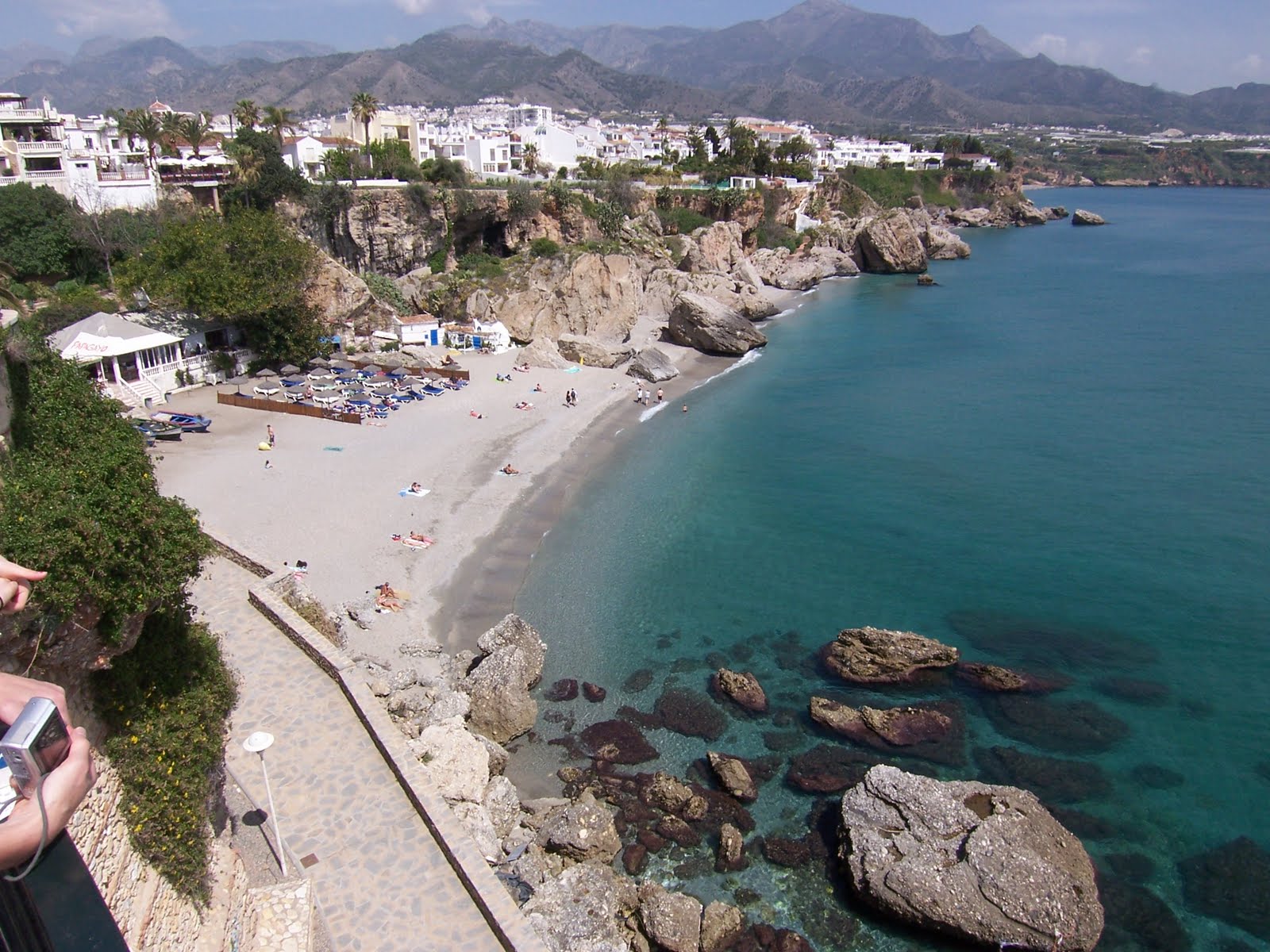
About 40 minutes from us is a lovely little coastal town called “Nerja”, pronounced "Ner-ha". It is known as the “Balcony of Europe”, a phrase coined by a Spanish king when he came to survey the damage done by the earthquake in 1884. Nerja is beautiful and has beautiful beaches as well but its real claim to fame are its caves.


The Caves of Nerja were discovered in 1959 by five boys. They were exploring. As I walked through the amazing cavernous spaces I marveled at how courageous these boys must have been to come in. The caves go on and on for 5 km! Only a small section is open to the public. It has cement walkways and strategically placed lights in order to reflect the immense size and dramatic stalactites and stalagmites. It has the largest cave form in the world inside, according to Guinness. It is a stalagmite/stalactite combo that is 32 metres in height and larger than an ancient Sequoia in girth.

They’ve found evidence of human occupation from the Neolithic age and research is presently underway. There are paintings, fragments of tools and human remains. It is supposed that the caves were known for thousands of years before they fell out of use. What an incredible find for the boys!

One of the boys is still around. He runs an eatery on the big beach in Nerja. He is something of a local celebrity and has a larger than life personality. He became an athlete for awhile and then started this restaurant which hires “difficult to hire” people. We spent a second day in Nerja to partake of the paella feast he serves up at his beachside restaurant. The food was wonderful and watching them make it was even more fun.


They have a huge round cast iron pan over a roaring fire. They throw in a LOT of uncooked rice, and cooked chicken/seafood bits. They stir this up a bit and then add a large pail of murky looking water. The water must have a lot of spices in it because if not, it was probably not a good idea to have eaten there. The pan bubbles wetly and every so often, various men stir it up with a long stick. After they deem it cooked, two men heave it from the fire to place it on the cooling rack where it sits for ten minutes or so. The chef periodically comes by to spoon a bit near the edge.

Finally, he begins serving it onto plates. He just continues to spoon out generous portions until the whole pan is empty. All the food disappears as fast as he can serve. We figured it must be “all you can eat” because several diners went back for more. I don’t know HOW they could have still been hungry as I couldn’t even finish my first portion. Paella was a dish the poor farmers used to eat. It was first produced in Valencia and spread throughout Spain because it was easy, cheap and filling. I can’t imagine the poor farmers had quite as much meat in their paella, though.

The meal was delicious with lots of chicken, prawns, clams and maybe scallops but they weren’t in the shell so we weren’t completely sure. Most of the seafood chunks were the whole critter which made eating them tricky. One prawn on my plate was so large we weren’t sure if it was a prawn or not!


After lunch, we rolled our bloated selves onto the beach and lounged along with the rest of Northern Europe. It was fun listening to the wide variety of languages spoken around us. The Scandinavian group nearby seemed like fun and I thought it was a shame we didn’t speak their language. Mind you, add a never-ending flow of beer to any group and I suppose they’ll be fun. The water was cold but many people still went swimming because it was hot. Julia joined the ranks and took her first swim of the year. The rest of us chose to wait. We may not have long to wait though, because the weather has definitely taken a turn for the hot. It was 30 degrees on the beach!

Granada

We decided to take an overnight trip to Granada. It is only 1.5 hours away but it seemed like an awfully long day trip and there was a lot to do in town. In planning, I realized that you had to make a reservation to get into the Alhambra (the reason so many visit) and that the place was almost fully booked all month because of the Easter celebrations. The only time available was the next day!


So off we went. We spent a day walking through the town and a morning visiting the Alhambra. Granada is famous because it was the last stronghold of the Moors. Ferdinand and Isabel were on a rampage to make Spain a unified shrine to Catholicism. In fact, their zest for Christian domination was such that they would have lit the world if they could.


It all began when Ferdinand, King of Aragon, married Isabel, queen of Castile, thereby uniting two major provinces of the Iberian Peninsula. They shared a passion for Christ and a passion for power. They wanted to unite the whole of the peninsula and set about driving out the Moors. Sadly, this passion for saving souls gave the footing for the Holy Inquisition to gain a stranglehold on Spain, spreading more fear and suspicion than love and eternal life. In the ensuing years, they succeeded in pushing out the Muslims and Jews and creating a Catholic country, albeit a rather subdued Catholic country.


When Boabdil, King of Granada left, Ferdinand and Isabel moved in. They set up shop right in his beloved Nasrid Palace. Then they brought down the town mosque and built one heck of a huge cathedral right over top. We like to call it the “Ha Ha” Cathedral. It dominates the landscape. You can see in the picture above how big it is compared to the rest of the buildings around it. Inside it is big enough to contain a forest and it has its own weather, I think. The temperature is several degrees colder in the cathedral than on the street. The focus of the cathedral is on Mary as the newly converted Muslims who stayed had an easier time praying to her because she is in the Koran (Muslim bible). Inside the cathedral they still have a huge pictorial work displaying Saint James swinging his sword atop a horse while a Moor writhes beneath the horse’s hooves. That had to chafe at the new converts.


Ferdinand and Isabel then decreed that everyone should eat pork because Muslims and Jews can’t eat pig meat. To show you were following the correct faith, you ate pork. Even today you can find more pork dishes than anything else. The grocery store has a whole aisle devoted to ham hocks. This move helped to prevent Muslims and Jews from returning to Spain as well. There are some 700,000 Muslims living in Spain today and 5 million living in France. I guess it worked.


One other interesting tidbit about the Alhambra is that this is where Ferdinand and Isabel received Christopher Columbus and agreed to his terms for sailing west to discover the east. We saw the room where this happened; a perfect cube of a room, perhaps appropriate for a sailor about to prove the earth was a sphere. I thought it was interesting also that Rick Steves said that most people didn’t believe the earth was flat at this point but simply thought it was far bigger than Columbus had calculated.


Beside the huge cathedral is the final resting place for Ferdinand and Isabel. They may have gone about things in a frightening manner but they are credited with uniting Spain. Their bodies lay entombed in a chapel next to their grandson and his wife. I wonder how they feel about that. Philip the Fair died before his wife, Juana the Mad. Juana was so overcome with grief that she had his body set out in her bedroom and kissed him goodnight each evening for TWO YEARS. I believe this may have been when “the Mad” was attached to her name. I wonder if this is why the bodies of Spanish royalty now have to “ripen” for 90 days before they can be entombed in the El Escorial pantheon.


We also spent some time wandering around the streets. We saw an old caravanserai, the last of the original fourteen camel watering holes. When travelers would come to Granada, they’d stop at these places to sleep, sell their wares and swap stories. This place was completely hidden by more modern buildings surrounding it. Not far from the caravanserai was the Alcaiceria (muslim market in the style of souks). The streets were very narrow and the multiple shops sold mostly the same tourist junk but it was fun winding our way through it. Way back when, it was created as a silk market and had armed guards. Silk was a very important product controlled by the sultan. We didn’t see any silk but we did see the Roma ladies who push rosemary at you in the hopes they’ll con you out of a few coins by telling your fortune. We didn’t fall for it. It was tame compared to the Egyptian souks and the poor gypsies didn’t stand a chance.


We explored Sacromonte, an area of Granada that has mostly Roma people. This is one of the only places in Spain whree the Roma have a neighbourhood they live in rather than being integrated into the city. The people of Granada think the Roma isolate themselves. At the entrance to the district there is a statue of Chorrohumo, a famous Roma man who used to give tours. The word "chorro" is a slang term for "thief" so it is kind of a play on words in Spanish. Not sure how the Roma feel about that one. There were also lots of Flamenco bars but we had already decided to go to a show in Sevilla, capital of Flamenco.


Now, Granada and the Alhambra was an interesting place but perhaps the MOST interesting was when we had lunch on the street. We sat eating our sandwiches when a woman strolled past with her pubic hair flowing over the top of her low-rise pants. Well, it was either that or some small, dark animal was fighting its way out. Rhys and I were the only two privileged enough for THAT eye-full and we both looked at each other in “was that what I think it was” horror before bursting into gales of laughter. You'll be pleased to know we didn't get a picture of THAT one for you. Just when you think you’ve seen it all.

Monday, April 4, 2011

In Search of the Sun

We drove from Lisbon south to the Algarve. This is the sunny south coast of Portugal where snowbirds from the north fly each year seeking the heat. We stopped for lunch in a lovely little town called Olhao. We were not disappointed by the temperature. We left Lisbon at 13 degrees and arrived in Olhao at 26 degrees. That was a 2.5 hour drive. Imagine driving through half the country and doubling your temperature in 2.5 hours! Makes one think…


From Olhao we drove on along the coast to Spain’s Costa del Sol (Sun Coast). This is an over-developed wasteland of English tourism at its worst. However, we left the coast along a torturous winding road through the hills to the tiny village of Almachar where we have rented a house for the month. The coast is about a 20 minute drive. If you are a bird it probably takes about 5 minutes because you are not slave to the scary, “we’re all going to die here” roads. Most of the towns we passed cling to the side of the hill and I was glad they weren’t Almachar because they made me quite breathless. Our village clings to the side of the hill but at least the bottom of the hill is also the bottom of the village.


We arrived in the middle of senior’s week and old men covered the village square. I don’t know where they were hiding the ladies. There was much frivolity and laughter. We stood gazing around us somewhat bemusedly until our host stumbled out of a nearby bar in jolly good humour. He described how to get to the next plaza in our car and we gamely drove forward through streets that were most likely paved goat trails. From the plaza, we unloaded the bags and followed John the Man up and down more twisty streets to our new home.


This is by far the nicest place we have stayed. There are three floors built around a central courtyard in the Moorish style. The courtyard is not open to the sky but has a large skylight covering it letting in the light. There is a terrace entry that looks out onto the street. Our front door enters into the dining room which has heavy curtains in the doorways to help keep the heat in should we need it. The courtyard is next and then a Turkish looking living room beyond. The kitchen and a small bathroom also reside on this floor. The courtyard has a large staircase that winds up to the next two floors. The middle floor has a walkway around and four bedrooms and two more bathrooms open off of this hall. At the top level there is an open foyer where we have set up the computers, another bedroom and a large rooftop terrace with a killer view.


The skylight heats the upstairs so the top floor is the warmest and the ground floor is very cool. They have English satellite television, a DVD/VCR player with movies and all of us feel as though we have fallen into the lap of luxury. Our hosts are quite funny and have oodles of information prepared for the surrounds. Judy even prepared a list of events taking place over the next month in the small villages nearby. Of course, the first three days we spent just sleeping in, lounging on the rooftop terrace and indulging ourselves. Oh, that was just Tom and I. The kids worked on schoolwork.

Sunday, April 3, 2011

Post Heather Sintra

We dropped Heather off at the airport early in the morning and then headed home to gather the children for a trip to Sintra. Sintra is what must function as the Loire Valley of Portugal. The rich and famous settled themselves here, building palaces to reflect their stunning wealth. It was first founded by the Romans who called it “Cynthia” after the moon goddess. We had no idea what to expect but the lush tropical greenery was definitely a surprise. We felt like we had stepped into a jungle. Somebody back in time must have been a horticulturalist because there were trees from around the world on one of the palace properties. They even had Sequoia! It felt like we were back home in the forests of BC, although the foliage was just a bit too thick looking, with lots of vines. Vines really aren’t a BC thing.


The first castle we visited was a Moor castle ruin. It had been a fortress overlooking the town where every year, the castle occupants built a huge fire to remind the villagers the castle was here to protect them. The last occupant was a painter/king who spent quite a bit of time atop the castle’s highest point, capturing the view with his palette. For me, the best part of this castle was the thick jungle look surrounding it.


From here we hiked up to the Pena castle. This had been the site of a monastery until the big 1755 earthquake. After that, none of the monks was particularly eager to stay and the palace wasn’t restored until some years later when one of the Portuguese kings bought up the land and renovated. The result was quite stunning. The palace is painted bright colours and has a distinct Moorish flavour. It was quite different from the other castles and palaces we have visited. For one thing, the interior spaces had much lower ceilings, creating a homey feeling. The castle dining room seated about twenty rather than 144. It felt very liveable. The living quarters were built around a huge interior courtyard letting in light to all rooms. Pena has been compared to Neuchwanstein and other Bavarian castles by Mad King Ludwig but it was the final palace that we thought most reminded us of the crazy king. The whole palace was surrounded by extensive gardens with plants from around the world. We were on a bit of a tight schedule so we opted to skip the garden tour and go for lunch instead.


We had a forgettable lunch in town before walking up to the last palace of the day. This one was the best. It was Regaleira, built around the same time as Gaudi was doing his thing up in Barcelona. Gaudi didn’t participate in this estate but you could see he would have loved it. The mansion was wonderful with a library whose floor appeared to float. The room was poorly lit and when you peered through the door you could see that the floor didn’t reach to the walls and the stacks of books appeared to extend from the floor below right up past you to the ceiling above. It gave one pause. A couple of men stood in the doorway, wanting to go in but unsure how the floor was supported from below. I mean, one wrong step and down you go. What kind of tourist trap was this? We could see a door on the other side of the room and as Tom pointed out, if it was dangerous they wouldn’t have the open doorway. The men wouldn’t move out of the doorway though. They wouldn’t go in but they wouldn’t move to allow others in so I went down and around to get to the other doorway. By the time I got there, Tom was in the room with several others. The floor had mirrors all around the outside, giving one the illusion of a floating floor. Isn’t that neat? My mind is racing with ideas for my library…


There were also extensive gardens surrounding this place and it was fortunate we took the time to explore because there were more exciting mystery features throughout. The grounds were on a hill (isn’t all of Europe?) and there was a well built to take advantage of the slope. You could enter from the top or bottom. At the bottom were tunnels leading to other areas and in the middle were secret doors to get out. The doors looked like solid rock but if you pushed they would spin. We took a video so you can see the Scooby-Doo effect. The view up or down in the well was also quite striking.


When we got to the bottom of the well, we walked through the tunnel to a beautiful little lagoon. The rock had been carved out to create picturesque settings. The water was covered in algae, making it look like a green carpet. There were stepping stones across the water and a bridge over the top. Tunnels led around from one opening to the next and the whole effect was dramatic and exciting. It was like a fantasy come true. We followed the other tunnels to their end but the most interesting place was the well and lagoon. What fun they must have had designing that. In all, this was a great day.

The Lisbon Experience

Our neighbourhood was an older section of Lisbon called Alfalma. This doesn’t mean much in Lisbon because in 1755 there was a huge earthquake that leveled the city so the whole city is essentially only a few hundred years old. That’s kind of like Canada, really. After the earthquake, the city was rebuilt on a grid plan but somehow Alfalma escaped the grid. The fact that they rebuilt multi-level homes on steep, winding streets demonstrates the lack of “earthquake” awareness. You’d think them guys would not be too keen to live on slidey slopes after the one-two punch of the earthquake/tsunami…but then we have the whole “West Vancouver” phenomenon back home so I guess the killer views beat out the killer quakes.


Alfalma was the kind of area where you weren’t quite sure if the Bohemian atmosphere was ultra cool or life threatening. Do you make eye-contact with the large crowd of youths and say “Hola” or slink on by hoping they haven’t noticed your bright white tourist-type skin? The best part was the trolley cars. These yellow trams raced up and down the narrow, twisty streets forcing their passengers to hold on tight as they jerked and lurched about. The shops were fun to browse and we found several worth hanging out at for a while. One was the Port wine store. The salesclerk was quite friendly and chatted to us at length about various Port wines. Heather wanted to pick up a bottle so we had to taste a few Ports. We discovered that we all liked Port. As we chatted, he decided that to truly appreciate Port we should taste his 130 Euro bottle. We discovered that we all like expensive Port. Then we saw the Port jam. It is made from a thicker wine sludge and is eaten with cheese. It was fantastic and I wanted to get a jar but at 20 Euros we decided to pass. Instead, we crossed the street to where they sold tinned seafood products and invested 1.70 in a tin of marinated mussels.


From there we wandered about to a ceramic tile store and spent an enjoyable twenty minutes or so chatting to the owner there. He regaled us with tales of Portuguese history and encouraged us to visit various parts of the city. He insisted we visit the museum where the ancient mariner maps were housed so we could appreciate the importance of the water to Portugal. The Portuguese at one time had pretty well owned the seas. They controlled the maps of routes to India, China and islands along the south of Africa so they had the spice trade routes tied up. When Christopher Columbus came along, they turned him down; a mistake in hindsight, of course, but at the time, they were the strongest seafaring nation on the planet so his crazy “round the world” ideas weren’t necessary to fill their coffers.


They must have been a wealthy nation because it is reflected in all of the architecture and beauty of their port city. The whole city had to be rebuilt pretty much all at once and the costs must have been staggering. Therefore, every statue, monument and decoration adorning the streets is an impressive testimony to their wealth. The Port entry is magnificent. Pulling up in a tall-masted ship here, you would really feel like you had arrived.


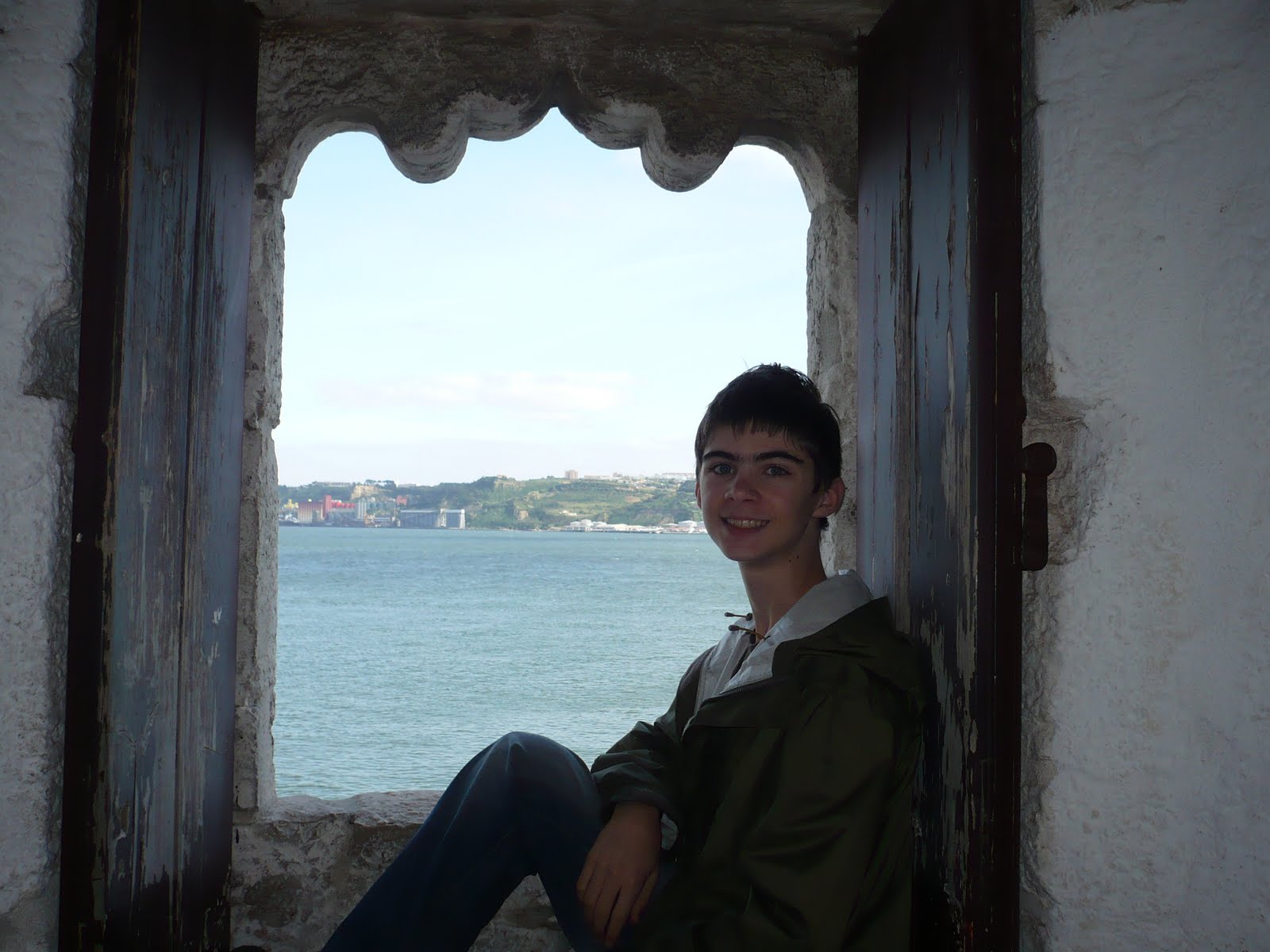
Another sight we were encouraged to visit was the Patisserie Belem to try the famous Lisbon tart. According to our ceramic tile guide, visiting Lisbon and not trying this tart at that Patisserie is like visiting Rome and not seeing the “Papa”. Naturally, we made a special trip the next day to Belem, home of mariner maps and tarts. The tarts were a bit like a vanilla custard tart and were quite delicious. The mariner maps stayed hidden from our foreigner eyes as we opted to see other monuments that caught our interest. It was a beautiful day (unlike the monsoon weather the day prior) and we enjoyed lunch on a patio before wandering to the seaside to look at the stunning Lisbon Mariner Monument. We watched a long promotional movie inside which shared many, many repetitious facts and pictures but the one thing that we did appreciate was that the Romans had called this place, "Felicitas Julia". From the top we could see in all directions and took lots of neat pictures. The large bridge may look like the Golden Gate in San Francisco but the towering statue of Christ hovering at one end helps ground you back in Portugal. We also explored the lookout tower that had once been an integral part of the defense system for the port city. It was very picturesque with its Moorish style window frames.


For Heather’s last meal with us, we all ventured out into the dark streets of Alfalma to find a Fado bar. Fado is a type of music specific to Portugal. It doesn’t start until quite late, though, so although we were eating after 8pm, we missed the show. We did find a restaurant that had taped Fado music playing in the background. It was a little hole in the wall with about five tables. They immediately brought bread and a dish of grilled sausages to nibble on. We’d had some experience with this at a restaurant prior so we weren’t overly enthusiastic about eating it but we were hungry. The previous day’s lunch, the waiter had placed bread and a plate of cheeses on our table. When food comes without ordering, one naturally assumes it is gratis. Not so. The cheeses turned out to be 3.50 each and added up to an extra 14 Euros (about $18)! We were not pleased but assumed this was a Portugal thing.


The menu wasn’t written down and the owner described our choices: meat with rice and salad, fish with rice and salad, mixed grill with rice and salad. The adults went with the mixed grill and the children requested beef but when the meals arrived they all looked suspiciously the same. The food was very good, however, regardless of what was actually being served as meat. The wine was the real star as all Spanish/Portuguese red wines have been. I have never particularly cared for wine but I must say that the wines here are quite yummy. We asked if the children wanted to try a sip and the host ran to get more glasses and poured Julia a very generous “sip”. For Rhys, he poured a whole glass, beaming the entire time. Rhys was horrified and Julia was intrigued. They both tried a sip but declared it not as good as the water. At the end of the meal, the hostess brought us each a glass of Port (not the children as they’d had enogh to drink by then…just kidding Mom). The whole meal came to about $12 each (the grilled sausages and Port wine had been free). Rather reasonable we thought for a fun experience and a great feast.

From Madrid to Lisbon

The four of us travelled to Lisbon with my friend, Heather. Kenna and Ray had to fly home to work but Heather had a few extra days and being the risk-taker she is, she decided to spend them with us. Now the strain on our family was considerable you realize; keeping up the illusion of pleasant, cooperative and easy to get along with for longer than one week put the four of us to the test. Believe you me, after she left this morning the gloves came off. I suspect she probably noticed a few cracks in the façade but I am convinced that on the whole, we managed to pull off the “happy family” routine fairly believably.


We broke up the long drive from Madrid by stopping in the small town of Evora. People stop here to see the macabre bone church. Being a macabre sort of family we had already seen a bone church in Kutna Hora, Czech Republic so we were prepared. It still didn’t stop the chill you get from seeing skulls used in a decorative pattern around the ceiling tiles. There is something quite unsettling about seeing human bones used so casually. The inscription over the door reads, "WE bones are here waiting for yours". Okay, so if that isn't the height of creepiness... Heather thought it would be a great honour to have your bones in the church, as they were closer to God. I wondered how honoured the souls would feel realizing they were part of the designer print wallpaper. It is difficult to tell from the pictures, but that wall that looks like stone is bones: skulls, etc. It was a bit confusing trying to understand which branch of Christianity saw the use of human bones as art as a viable option. The fact that there is more than one bone church in the world did not escape our notice either. Heather wondered if it was the same branch of the faith. It is more macabre to think that more than one branch thought this was cool. I think about the people who have difficulty donating their organs after they die. What would they think about this?


Evora was actually quite a charming little place, bone church aside. We had some lunch, strolled through the winding streets and discovered several other churches and a Roman temple for our efforts. Those Romans seem to have left a calling card pretty much everywhere we visit.


We arrived in Lisbon that evening, taking a bit longer than usual to get in to our place because one of us (all right it was me) had written the phone number down wrong. The apartment was a real hoot. The door was built for scrawny hobbits and it threatened to deny access to our luggage. Once in the door, the staircase was more like a ladder with walls. The people who live in this building are definitely not fighting a weight problem. Our pad was on the top floor, naturally. The apartment itself was great, with a lovely view up the street and enough space for all of us. The biggest drawback was that the promised Internet didn’t work. Oh, it SAID it was connected all right. It just wouldn’t allow us to use Internet Explorer. We tried a variety of options, none of which worked. We later decided it must be a Portugal thing as we couldn’t get the connection to work at the local McDonald’s either.